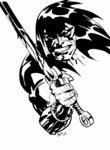
Live By the Sword

Why have the folk storytelling traditions of the British Isles never really been reflected in the cinema produced here? These Islands are rich in myth and have an ancient tradition of storytelling, but British cinema has long seemed oblivious to both. Partly the success and influence of American cinema is to blame. In America, the first narrative film set the tone; it was a Western, a uniquely, distinctively American genre, and that genre was instantly embraced as the American genre, somehow embodying the American national myth.
Genres that were not native were rapidly Americanised: the Gangster story made more sense in America during and after the Depression and Prohibition than it ever had anywhere else before, and Hollywood took that area and established iconography and modes for it only slightly less powerful than the ones it had crystallised for the Western before it.
So British genre cinema already had a model in the earliest years of the medium as a commercial concern. And though British studios made thrillers and War films and adventure films and crime dramas, they were all, on some level, imitations of the American films playing in British cinemas. Most European Nations had similar issues: they made Westerns in Germany in the 1920s, and in France and Italy the dominant genres in the early years of Film were crime thrillers. German expressionism elevated the horror film but this was a brief aberrative period and American Cinema absorbed what those German films had done and made it mainstream and normalised. What Europe did well, even at that point, was heritage drama, costume period pieces akin to the traditions of much European theatre and literature. This was as true of Britain as it was of France.
But the big British National myths: the likes of King Arthur, Robin Hood, Dick Turpin and even the lesser-known Spring-Heeled Jack, they were never definitively tackled by British cinema. Director Percy Stow made a silent Robin Hood film in 1908 but in 1922 Robin Hood, an American silent starring Douglas Fairbanks, was released and became a massive hit. The version of the character featured in that film - the swashbuckling, mustachioed hero - entered into the collective cultural consciousness and that iconic figure was solidified by the 1938 The Adventures of Robin Hood with Errol Flynn. Here was a British figure as interpreted by American Cinema, British myth repackaged for a Global Market by American tastes. King Arthur suffered a similar, though far less commercially successful, fate, even suffering the indignity of becoming a massively popular musical on stage and screen. Both icons would in time become the subjects of Animated Disney Films, making them culturally fixed as American icons as much as British.
Later British television would repeatedly address these characters, but they had been already co-opted by Hollywood and these portrayals are generally revisionist reimaginings working in the shadows of the American versions. The popular 1980s series Robin of Sherwood, for example, replaced the primary colours and straightforward manichean conflicts of most Robin Hood stories with a dirty realist visual approach - most likely taken from Richard Lester's superb Robin and Marian - and stirred in some Celtic mysticism and a little historical licence (one of Robin's Merry Men was a Moor), but British cinema, by the 1980s, never really waded into such waters.
All of this left Britain - from early on in its history as a film-producing Nation - without a natural action genre of its own. British adventure films had no fixed form; there were Colonial films set in the jungles of the East, the occasional American-style period swashbuckler, the odd Western-aping Highwayman film, War dramas and Spy stories, which could have been Hollywood productions if the accents of the performers were to change.
In contrast a nation like Japan already produced a steady supply of Samurai films and China had a rapidly developing Kung Fu cinema industry. Both these genres had similarities with the Western, but this was not quite a disadvantage, as the happy influence of John Ford, say, on the films of Akira Kurosawa suggests, and they were clearly indigenous genres which could have been developed nowhere else.
In the last few decades, the commercial instability of British cinema, by now a fraction of the industry it was in the 1940s and 50s, much of its creative and technical personnel at the service of American money, has meant that a couple of sub genres have tended to dominate production here. Britain has excelled at realistic drama since the "kitchen sink" movement of the 1960s, and much British output still takes this approach. High-profile directors like Ken Loach, Mike Leigh and even Shane Meadows all fall under this broad umbrella-term. Costume drama, driven by the continued popularity of television productions made by the BBC and ITV, is a consistently successful British form, much of it based on an unparalleled National literature, from Shakespeare, Dickens, Austen and the Brontes to Evelyn Waugh and William Golding. And the British sense of humour means that Comedy is still a thriving genre, with television providing a steady stream of creative comedic talent for Cinema. But action subgenres tend to copy Hollywood forms to a slavish extent; with the post-Tarantino mockney Gangster films of the 1990s ( which altered little about the American gangster genre) an obvious and dispiriting example.

Sword and sandal films, however, for lack of a better term, have recently begun to crop up in a fascinating little mini-Wave. Britain has the history, landscape and creative and technical know-how to thrive in this genre, but these films are really a sub-genre, albeit currently quite a rich and fertile one.
The release this month of Kevin McDonald's The Eagle offers up a fascinating contrast to the films I'm discussing. It is a big prestige Hollywood production, featuring a few rising stars( Channing Tatum, Jamie Bell, Tahar Rahim), made by a Director becoming a solid, somewhat anonymous craftsman, with strong production values, a massive marketing budget and the intention of being a classy, roundly entertaining epic.
Compare it to Neil Marshall's Centurion from last year, a film with a near-identical settting and somewhat similar premise. Marshall's film is a B-movie, quite proudly a bloodthirsty, action-heavy genre film with a budget roughly half that of McDonald's. The films share some characteristics; these days, dirty realism rules in period portrayals of the Medieval or pre-Medieval World, and so we get to see a world of mud and rust, dirt-streaked skin and tattered clothing, mostly rudimentary buildings, harsh weather and inhospitable landscapes.
But while McDonald's film is somewhat ambitious - it wants to be about Rome and colonialism, it wants to develop it's characters and give them journeys (it's not entirely successful in fulfilling these ambitions) - Centurion only has one ambition: it wants to be a ride. It prizes narrative momentum and exhilarating action scenes above all else, charging along in one long pursuit, interrupting itself only for violent combat and one inevitable romantic interlude.
Both films heavily feature sword battles, and it is perhaps here that Marshall's film reveals it true nature most freely. The violence in The Eagle is serious and visceral, reflecting McDonald's desire for the film to have some impact, and yet it remains strangely tasteful throughout, too sober in intent and careful in execution. The violence in Centurion is almost exploitative, with eye-stabbings and clubbings and limb-choppings featuring prominently amidst a sea of blood.
There is a long tradition of ultra-violence in Sword & Sandal cinema, some of it even originating in the genre's Half-brother, the Historical Drama. Orson Welles' Chimes At Midnight is notable for horrendously visceral battle scenes, and Robert Bresson's Lancelot du Lac juxtaposes its angsty conscience-wrestling and philosophising with Knights beheading one another so graphically it's worthy of Sam Peckinpah (and was soon parodied by Monty Python). Stanley Kubrick's Spartacus (in the restored version from the 1990s, at any rate) features a couple of eye-popping action scenes, as does Clive Donner's Alfred the Great, and Mel Gibson's Braveheart, a film heavily influenced by Spartacus, pushes that angle even further, featuring extended Epic battles of stunningly gratuitous brutality: picks stud eye sockets only to erupt out of skulls, maces crush cheekbones, torsos are wrent asunder, limbs casually lopped off.
Marshall is the sort of director who is surely aware of this history. His previous film was the derivative movie geek wet dream Doomsday which mixed Escape from New York, Luc Besson and Mad Max to mediocre effect, but he would surely understand that many fans of Sword and Sandal films love the genre chiefly for its old-fashioned action, for men fighting with swords. Peter Jackson, another movie geek Director, understood this and his adaptations of Tolkein are filled with lavishly detailed and brilliantly executed battle scenes which crib from Kurosawa and Kung Fu movies as they go. These new British Sword and sandal b-movies all appreciate that bloody mayhem is a huge part of the appeal of their genre, and they are made by writers and directors who are extremely aware of the many ways such mayhem has been approached in the past.
So Centurion is really a revisionist 70s chase Western in disguise, with Picts replacing native Americans and Roman Legions instead of U.S. cavalry. But British history is long and interesting enough to have room for this story to be told - it could even have been set in an entirely different era with different sets of combatants; Vikings or Normans, the Civil War era, the Dark Ages - and still have qualified as a Sword and sandal film. Christopher Smith's Black Death, for instance, follows a disillusioned monk and a jaded bunch of Mercenaries during the 14th Century plague outbreak as they journey into eerie marshlands in search of a town reputedly free of infection. Financed and shot in Germany, Smith's film qualifies as British because of its setting and key creative personnel. Some of its most important influences are uniquely British, too. It seems to refer to three cult classics which all investigate the old, weird Britain of isolated rural communities and surviving pagan traditions; The Wicker Man, Blood on Satans Claw and Witchfinder General. In Smith's film, the Mercenaries, led by Sean Bean's iron-willed homicidal zealot, are searching for Witchcraft and they get that and more in this creepily mellow community (a sidelong suggestion of contemporary New Age worship is set with the costume design). The directors three previous films were all horror movies and he does a fine job here of maintaining a sense of dread and foreboding throughout, though the avoidance of the supernatural and ultimately human nature of the evil they encounter adds to this film's pessimistic impact. The coda is devastating, and if Black Death does have some aesthetic ambition, it's heart seems resolutely pulpy. It's battle scenes are filmed with real relish and gory aplomb and Smith has described it as a "men on a mission movie".

There are quieter, almost meditative moments in Black Death, however, and passages of it reminded me fleetingly of Andrei Tarkovsky and most particularly his extraordinary Medieval Epic, Andrei Rublev, which is, amongst other things, a fine example of Dirty realism in this genre. The Continental European approach to treatments of these eras has long differed from that presented by Hollywood. Directors like Frantisec Vlacil, Tarkovsky and Grigori Kontisev each depicted a muddy and brutal world where life was difficult, violence never distant, and death close behind it. Yet each was able to broach big, often awkward themes in his work: Kontisev's Shakespeare adaptations are as close to the complexity of the plays as any of the English-language versions, Vlacil's superb Valley of the Bees and Marketa Lazarova both examine themes of faith, loyalty and morality, and Andrei Rublev is a searching investigation into art, creativity and spirituality. Yet each made spectacular and beautiful films, convincing in their historical detail and authentically atmospheric. Perhaps the finest example of European art cinema treating the Medieval era, however, is Robert Bresson's fabulous Lancelot Du Lac, a mysterious, subtle yet grotesquely violent treatment of the Arthuran legend which Is unique in Bresson's filmography for it's strange Peckinpah-reads-a-courtly-romance effect.
These new English films resemble those European productions only visually; in their production design and photography (although those films were generally in black and White the effect of their muted looks are well-suggested by modern cinematography). The artistic ambition and imagination of those European directors is no longer present in Sword and Sandal films. Even in Mainland Europe, art films no longer command large enough budgets to allow for period recreation on anything but a small scale. So a modern Russian Medieval film is more likely to be a copy of an American production like the Conan-plagiarising fantasy Wolfhound. Even Sergei Bodrov's impressive Genghis Khan biopic Mongol plays more like an American Epic biopic such as Alexander or Braveheart than a uniquely Russian, artistically ambitious piece of work like Andrei Rublev.
Much of this has come about because of the huge success of Ridley Scott's Gladiator. A massive worldwide commercial and critical hit which won Awards and made Russell Crowe a star after many near misses, Scott's film also suggested that the public retained an appetite for sword and sandal movies, done right. Many of the American films which attempted to repeat it's success floundered on one or more elements of the recipe required - in the case of Oliver Stone's Alexander, Wolfgang Pederson's Troy and even Scott's Kingdom of Heaven, they all miscast their leading man after Gladiator had demonstrated the need for an actor capable of suggesting some old-fashioned masculinity without sounding silly speaking the Cod-English accented dialogue the established conventions of the genre demand.
The look of these newer English films is directly influenced by the first sequence in Gladiator, where Maximus' troops battle barbarians in wintry Northern Europe. The cold grey-blue muddy look established by Scott in that sequence - and repeated in the early European scenes in Kingdom of Heaven - has been a feature of all these films, and the majority have also borrowed Scott's approach to the first major battle there: an approach he in turn took from Spielberg in Saving Private Ryan, involving shaky handheld cameras, rapid cutting, shallowness of field and overexposed film. One film obviously indebted to Scott and which has proven surprisingly influential upon the films I'm discussing here is Antoine Fuqua's King Arthur with Clive Owen and Keira Knightly. It plays almost like a stylistic template for this material: it has the dirty visual pallette, the gritty production design, the Orc-like native barbarians, the gratuitous combat violence, the Kurosawa lifts and the Shaky-cam action scenes which have all now become commonplace. Unfortunately, it also has a terrible script, predictable plot and some downright bad acting, all of which make portions of it feel hilariously camp.
The success of Gladiator obviously indirectly led to the creation of HBOs Rome, too, and that show has given this new English wave one of it's leading men. James Purefoy had been a jobbing British actor for years, popping up in lead roles on stage and in tv in all sorts of material but never making the big breakthrough any actor needs. His role as a proud and lusty Mark Antony was one of the most memorable turns in Rome and it demonstrated that he was comfortable with period dialogue and looked good in armour, as did his small but crucial turn in A Knights Tale.

In England, when a film like Jonathan English's Ironclad needs a leading man, it finds Purefoy. He plays a classic archetype; the Warrior who has seen too much War and suffers for it. He plays a Templar who has taken a vow of silence after years of butchery in the Holy Land but is dragged into a new conflict in England. This film appears to have a little ambition, it's story of Nobility in conflict with Royalty fairly quaking with heft and import. And yet, English is plainly most interested in the gritty detail of his protracted battle scenes, and his character arcs make sure to focus on the way these men are changed and effected by the violence they experience. An hour or so in, after a couple of gruesome deaths by blunt instrument and a few disembowelments, the central idea - that these common men are fighting for their right to a voice - has more or less dissipated amidst the clouds of blood. English steals liberally from the usual sources. His early "getting the team together again" scenes especially echo Seven Samurai, and he displays a fine understanding of the dynamics of these sorts of action sequences: the scene where Purefoy first unleashes his immense broadsword is terrifically done and appropriately awesome in it's violence.
Ironclad in fact picks up where Ridley Scott's Robin Hood left off; with the signing of the Magna Carta. This make a comparison between the films inevitable (it doesn't hurt that Jonathan English is obviously a big fan of Scott's historical films). Robin Hood, like The Eagle is a big budget studio tentpole production, with big stars (Russell Crowe, Cate Blanchett), massive action sequences, a bloated running time and a script that is a bit of a mess. Scott focuses far more than English upon the issues behind the creation of the Magna Carta, with much debate on rights and motivational speechifying from Crowe's Robin. This makes much of the film stolid, leaden and weighed down by it's determination to be serious. The action scenes are impressive enough - though the massive beach battle at the finale does feature a lazy slo-mo "Noooooo!!" - but English accomplishes more with a quarter of the budget. Crowe, with his brawny old-fashioned masculinity, was born for such meaty Historical roles and he carries the film as few actors could. Purefoy matches him, projecting an intensity that fits well with the sombre, bloody tone of the film. He had similar success in Solomon Kane, another violent semi-British historical pulp epic, where he played Robert E Howard's Puritan Warrior as a lethal, haunted West Country gunslinger, battling demons while praying to God.
Films like Solomon Kane and Nicolas Winding Refn's extraordinary Valhalla Rising don't quite belong to this sub-genre, though they are associated. Refn's film was shot in Scotland and is just as violent as any of the others I've mentioned, possibly moreso in it's unrelentingly savage first act, but it has aesthetic ambitions; a layer of pretension, even, which is beyond them. Comparable recent American productions, the Nicholas Cage-starring Season of the Witch, say, wander directly into camp territory even Centurion avoids, aided by a distinctively British yobbish sensibility. This is tricky material, a difficult period to get right, with a potential for a pantomime quality increased by the costumes and sets and hairstyles, but most of all by the language. Suggesting an archaic brand of speech in modern English is delicate, and having banal conversations about historical figures treads perilously close to Monty Python territory. Or, as one character in Centurion puts it: "A wall? Is that Hadrian's great plan?"
Much as I admire this rich young British sub-genre, I still mourn the absence of any films that really do capture the folksy, rural traditions of storytelling in Ireland and the U.K. instead of applying bastardised American genre principles to British history. But then European Cinema contains little of the kind of film I mean. The only example that springs readily to mind is Nils Gaup's excellent Finnish 1987 Pathfinder (Ofelas in Sami) which adapts a Sami legend into a taut, eerie and exciting adventure film which feels like it could almost have been made at any time over the last fifty years. I can't imagine anything like it ever getting made in a modern Britain so enslaved to mainstream cinematic modes and genres. And that's something of a shame.
Labels: british cinema, christopher smith, James Purefoy, Neil Marshall, nicolas winding refn, ridley scott, swordplay, violence
posted by David N at 3:38 pm
3 comments